
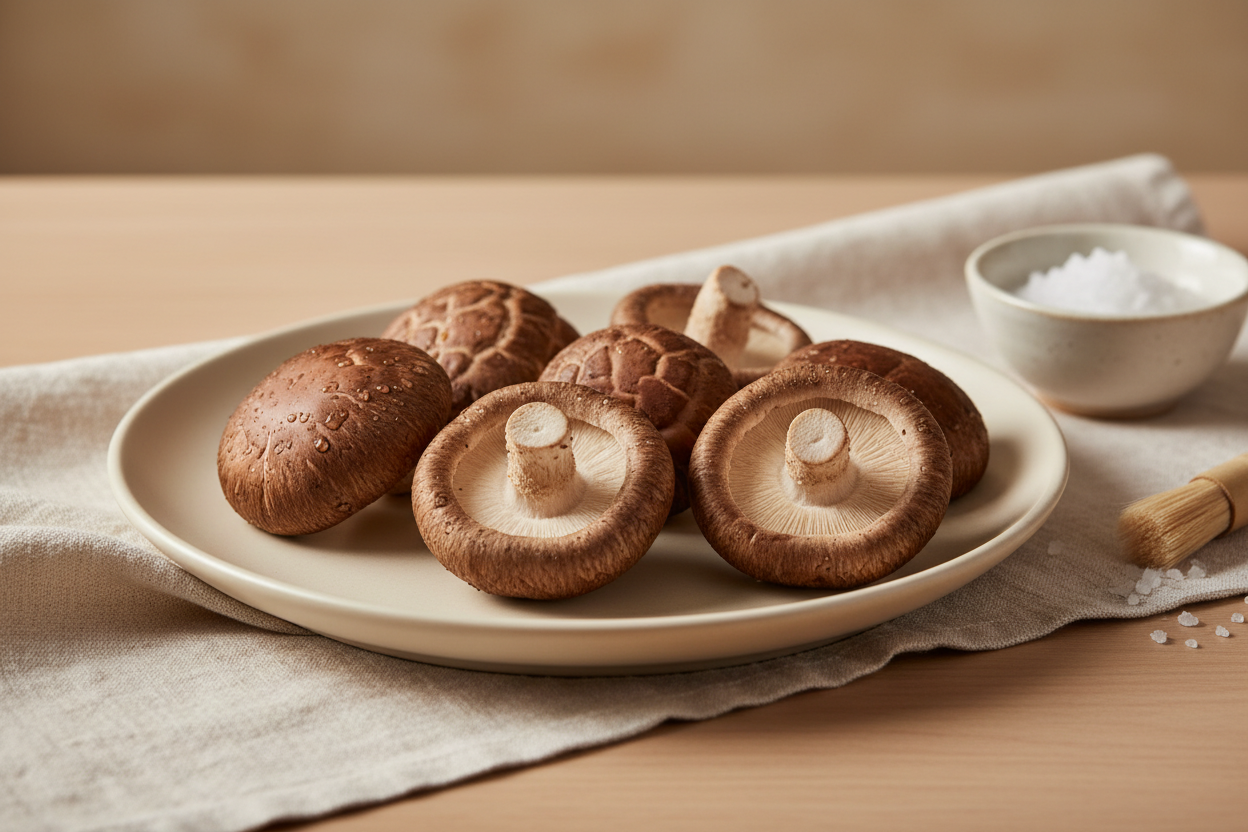
Shiitake: The Mushroom You've Probably Eaten and the Compound That Made Scientists Take It Seriously
Reading time: 6 minutes
Of all the mushrooms in a functional blend, Shiitake is the one you've most likely already eaten. It's in supermarkets, ramen bowls, and stir-fries worldwide. But behind the familiar umami flavour is one of the most-studied polysaccharides in the entire medicinal mushroom field a compound so well-characterised it has its own name.
What is Shiitake?
Shiitake (Lentinula edodes) is an edible mushroom native to East Asia, cultivated for centuries and now grown worldwide. In traditional Chinese and Japanese practice it was valued not just as food but as a tonic associated with longevity and vitality, and consumed both fresh and dried.
That dual identity everyday food and traditional remedy is part of what makes Shiitake interesting. Unlike Reishi (too bitter to eat) or Chaga (a woody growth you'd never put on a plate), Shiitake has a long, documented history of ordinary human consumption. For a supplement ingredient, that's a meaningful track record.
Lentinan: the compound that put Shiitake in the lab
Here's where Shiitake earns its place in a serious blend.
In the 1960s and '70s, researchers isolated a specific beta-glucan from Shiitake and named it lentinan after the mushroom's Latin name, Lentinula edodes. It's a β-1,3 glucan with β-1,6 branches, and it has become one of the most extensively studied mushroom polysaccharides in the world.
What makes lentinan notable is how specifically it's been characterised. Researchers have mapped how it interacts with the immune system binding to receptors like Dectin-1 and TLR-family receptors on immune cells such as macrophages, natural killer cells, and T-cells, and influencing cytokine signalling. In some countries, an injectable pharmaceutical-grade form of lentinan has even been used in clinical oncology settings as an adjunct therapy (this is a medical use, distinct from anything a food supplement does).
The point for our purposes isn't the medical application. It's that Shiitake's key compound is so well-defined that it's been isolated, named, and studied for decades which is a far cry from the vague "contains antioxidants" language most mushroom marketing relies on.
What the research shows and what it doesn't
Shiitake and lentinan have a substantial research literature spanning in-vitro studies, animal models, and some human clinical work much of it focused on immune modulation, and some on cardiovascular markers (Shiitake also contains a compound called eritadenine that researchers have studied in relation to cholesterol metabolism).
As always, honesty about the tiers of evidence matters. The injectable, pharmaceutical lentinan studies are a different world from an oral food supplement different dose, different delivery, different context. The oral, dietary evidence is more modest, and much of the strongest mechanistic work is preclinical.
So: Shiitake is one of the best-characterised functional mushrooms, with a genuinely famous studied compound behind it. That's its strength. It is not a proven oral treatment for anything, and we're not going to pretend otherwise.
Why the fruiting body and the extraction matter
There's a fascinating detail buried in the Shiitake research that makes our whole point for us.
One study compared beta-glucan extracts from the same Shiitake mushroom and found dramatic differences depending on the source and method: a commercial sample contained higher alpha-glucans (starch) and correspondingly less beta-glucan than a carefully-extracted in-house version. Same mushroom species completely different quality, depending entirely on how it was grown and processed.
That's the entire fruiting-body argument in a single study. Beta-glucan content isn't guaranteed by the name on the label; it's determined by what part of the organism you use and how you extract it. Mycelium grown on grain skews toward starch. Properly extracted fruiting body skews toward beta-glucan.
This is why THRILL+ uses fruiting body only for Shiitake, at a 10:1 extract ratio, with a verifiable beta-glucan specification a number you can actually check, rather than a name you're asked to trust.
The bottom line
Shiitake bridges two worlds: the familiar mushroom on your plate and the source of lentinan, one of the most-studied polysaccharides in mycology. We include it in THRILL+ as fruiting body because as Shiitake's own research demonstrates that's what separates a real beta-glucan extract from expensive starch.

Laisser un commentaire
Ce site est protégé par hCaptcha, et la Politique de confidentialité et les Conditions de service de hCaptcha s’appliquent.